

You Are Not a Problem to Solve
Restoration in a Culture of Fixing

Welcome to this edition of Walking the Liminal!
I’m glad you’re here! And if you’re a new subscriber, a special welcome!
I spent a good part of my life feeling subpar, as if everyone else had received the instruction manual of life and I had somehow missed out.
I searched for how to rectify that: the right action, the corrective insight, the new way forward, the approval that would never be enough.
Yet, every time I tried to participate in an outer based change, something in me cringed. I knew this wasn’t the answer.
Still, I wanted resolution, and spirituality became the next right place to land.
Change my insides and the outside will follow.
Change my thoughts and my life will shift.
True as these may be, they speak more of improvement rather than coherence.
Without realizing it, I was trying to do spirituality.
Learning the postures, the language, the accepted truths, meditating the right way.
Underneath it all, I was assimilating and transforming. Yet my narrow focus was still on transcending my problems.
I was living in my head, convinced understanding would teach me how to live.
Everything softened when I stopped reaching upward and outward and instead dropped downward and inward. I stepped into being.
Listening more to the sensations, rhythms, and responses of my body.
Finding care and compassion for myself.
Gradually, I stopped orienting myself around external doctrines, beliefs and teachers.
Not because they were wrong, but because something truer had begun to speak within.
I also began to see how our society trains us to be consumers, to give our power away.
This was the turning point.
Returning to myself as restoration.
Restoration Over Fixing
Restoration is about remembering.
We live inside a culture that profits from naming our faults and then selling us the solution to fix them. We’re constantly diagnosing.
⇨ What’s wrong with my body?
⇨ What’s wrong with my habits?
⇨ What’s wrong with my mindset?
⇨ What’s wrong with my productivity?
Religion has long carried this same logic.
Through the story of original sin, we’re inherently flawed and in need of saving. With redemption coming from outside ourselves, mediated through creed, authority, and control over how we believe and live.
Spirituality has absorbed this rhetoric too. Offering practices as tools to optimize the self, purify our being, to transcend discomfort and bypass the messiness of being human.
Much of what we’re taught is that life is a problem to solve, the self a project to improve, healing a matter of correction.
Restoration begins from a radically different place:
A recognition that there’s something in us that is already wise, oriented toward connection, and capable of healing when given the right conditions.
Fixing asks us to override ourselves.
Restoration asks us to return.
It doesn’t ask, what must be corrected?
It asks, what needs to be tended?
What needs to be remembered and brought back into right relationship?
From Self-Correction to Self-Relation
Self-correction places us in an adversarial relationship with ourselves.
Keeps us in a posture of surveillance. Watching, evaluating, and managing.
It imagines wholeness as something achieved through discipline and effort.
These serve a function, when exaggerated though they create fragmentation.
We learn to mistrust our impulses.
We learn to override sensation.
We learn to interpret discomfort as failure rather than communication.
Self-relation shifts the posture entirely.
It’s relational rather than corrective.
Instead of tightening around what feels off, we turn towards it with curiosity.
This doesn’t mean abandoning discernment. It means recognizing that our inner world isn't an enemy to conquer, but a living system.
Healing happens not through constant adjustment, but through contact.
Through staying present long enough for the deeper wisdom beneath our patterns to speak.
In this orientation, healing isn’t about becoming someone else.
It’s about learning how to stay present with who we are.
When Life Isn’t a Problem to Solve, What Is It?
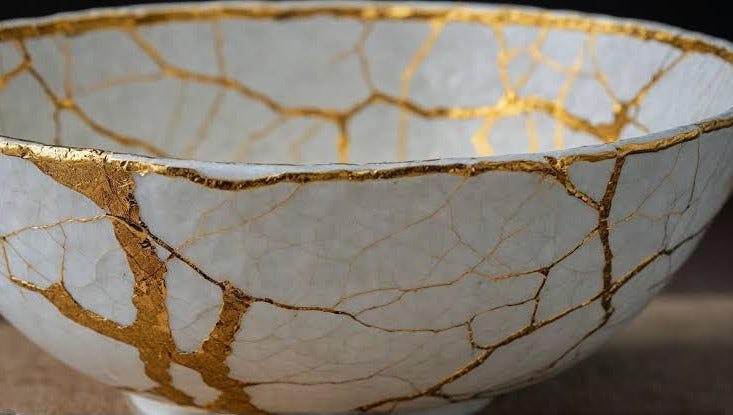
When we look to the Japanese philosophy of Wabi-Sabi, kintsugi is the practice of joining broken pieces of pottery together with gold.
Seeing beauty in what we have considered flawed or incomplete.
Augmenting the cracks with the illuminations of gold, as a compassionate means of honoring the way our life is showing up now.
Exhaustion comes from treating life as a series of problems.
⇨ Each season becomes something to get through.
⇨ Each challenge something to overcome.
⇨ Each pause something to justify.
If life isn’t a puzzle demanding answers, it becomes something far more intimate.
A living field we are in conversation with.
A rhythm we drop into.
Not every moment asks for action.
There is also witnessing, being patient, staying present.
Trusting that meaning will unfold, a return to coherence.
Restoration reframes difficulty not as failure, but as information.
It asks us to tolerate not knowing long enough for something truer to emerge.
To see that our relational field includes joy, confusion, grief, and change as natural movements rather than obstacles.
It becomes part of a larger conversation.
Restoration as a Practice
Restoration doesn’t conform to timelines or productivity metrics.
Instead it works in body-time, not mind-time.
It honors cycles, pauses, and the natural intelligence of release and renewal.
It happens through rest that doesn’t have to be earned.
Through pauses that aren’t meant to be explained.
Through allowing the nervous system, the body, and the soul to recalibrate in their own time.
As a practice, restoration teaches stewardship rather than domination,
reciprocity rather than living life as transactions.
We learn to tend this living ecosystem, by paying attention to what’s depleted,
what’s overstimulated, what’s asking for nourishment.
Sometimes restoration looks like action.
Sometimes it looks like stillness.
Sometimes it looks like letting something fall away without immediately replacing it.
It’s where nothing is rushed, nothing is coerced.
Perhaps the deepest shift is this:
moving from the question How do I become better?
to the inquiry,
How do I come back into right relationship, with myself, with others, with the living world?
Restoration does not promise perfection.
It offers something more durable:
a way of living that honors wholeness not as an achievement,
but as an ongoing remembering.
Remembering the wisdom in our bones,
the lineage that flows through our blood,
the intelligence of our nervous system,
the love that lives in our heart,
and the intuition that speaks from our gut.
Remembering our place within the larger body of life.
not separate, but woven,
held by rhythms older than time.
Here we explored restoration as individuals, shifting from self-correction to self-relationship. In future posts I want to continue this conversation exploring restoration in community, where healing is not a private achievement but something we cultivate together.


Offerings:
I offer tarot readings and one-on-one sessions, a held space of reflection designed to accompany your inner explorations, integrations and alignment with the rhythms of life. If this resonates, feel free to send me a message or visit my website for more information.
Thanks for reading!
I’m grateful you’re here! Connection is important to me, lets continue the conversation. If this spoke to you, please click the heart, write a comment, restack or subscribe. It helps extend the conversation beyond this space. 💜
Wow, I love this, Julie! It felt so refreshing to me to read about restoration instead of the old paradigm that healing means a return to wholeness. To me, that idea of returning to wholeness implies there's something missing, something that needs to be fixed...and all of that feels so dominator culture, doesn't it? As I'm sure it won't surprise you, I looked up the etymology of 'restore'. It basically means to stand up again, or to establish again. This reminded me of my whole, wild experience with the Hebrew word: Hineni. (I think I've shared the story with you.) As I understand it, Hineni means 'here I stand'. To restore, then, feels to me as a remembrance of that. As a remembering that I am here, now, in presence, in intimate relationship with the moment, just as I am, just as we are. It reminds me, too, of your teaching: my whole self is welcome here. Thank you once again for your amazing wisdom, my friend!
P.S. I skipped your post on Frozen River for now because, after we last talked, I had to start reading the book. I'll come back to that post when I'm finished. 🤗
Gosh, I love this so much, exactly what I needed to remember right now. Restoration not as a pack of rules to fix things and feel better in a crazy world but as a deep listening to what is needed in the depth of my being. Restoration as welcoming what is calling right now, may it be tears, fierce freedom, sacred rage, tenderness, and maybe all of this. Thank you for reminding me I'm not a problem to solve but a mystery to embrace and a sacred fire to tend to 🙏❤