

The Inversion Wound: Remembering Community in an Age of Isolation
From collective trauma and separation to relational healing and belonging

Welcome to this edition of Walking the Liminal!
I’m glad you’re here! And if you’re a new subscriber, a special welcome!
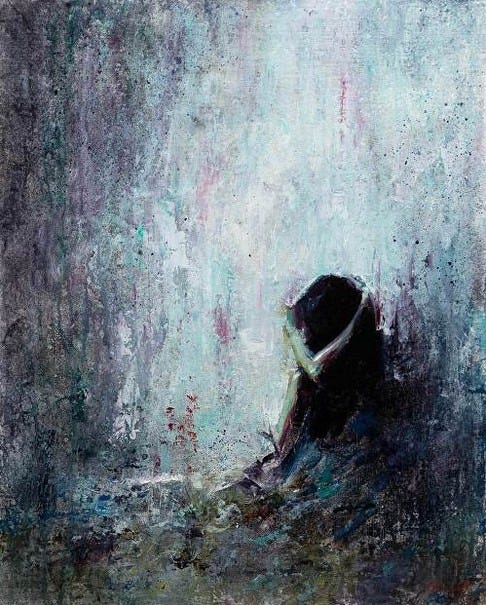
In 2023, U.S. surgeon general Vivek Murthy declared loneliness a public health epidemic in America.1
We’re living in unprecedented times of profound isolation, where separation has been normalized. Like many of us, I was taught to self-solve, self-optimize and self-heal, as though being human is meant to be a solo project.
In my last post, You Are Not a Problem to Solve, I wrote about the shame that arose from constant comparison. I believed that if I could only find the right answer, solution or action, my life would change.
I became another statistic, an outcome of a system that values independence over interdependence, productivity over presence, and individual success over collective well-being.
The deeper truth is that we’re social creatures by design. Beneath the smoke and mirrors of cultural doublespeak, we’re being called back to what is real: relationality, community, and family. We may all carry layers of trauma, but this doesn’t negate our need for one another. It just means coming together intentionally. Vibrant communities don’t just convene; they create belonging and shared meaning.
The Inversion Wound: The Collective Laceration
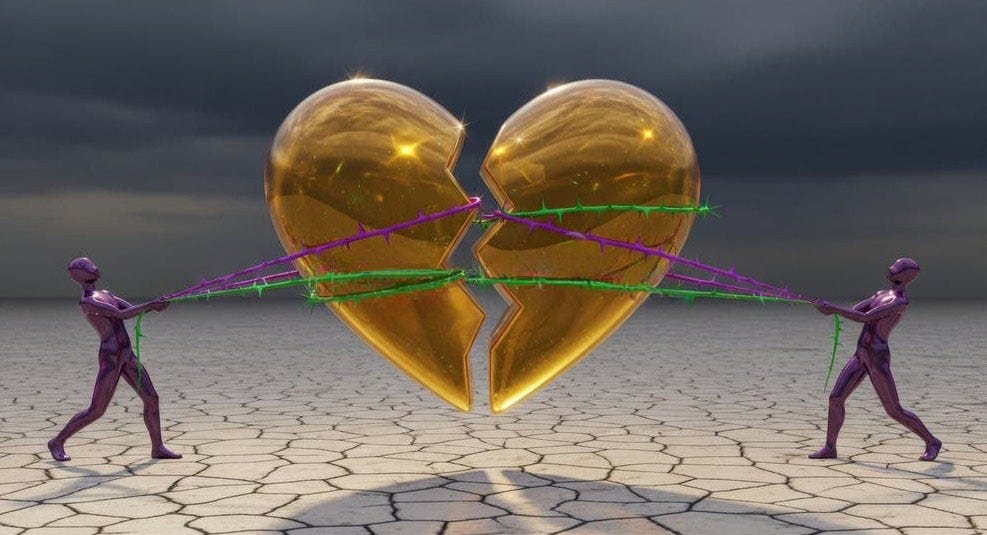
Community isn’t optional, it’s essential.
A profound wound tears through our collective consciousness. It’s called the Inversion Wound. Across spiritual and somatic traditions, it’s also recognized as the shadow, the witch wound, or the suppression of the Divine Feminine. This isn’t metaphorical! It’s lived trauma carried in our nervous system and encoded in cultural stories around power, gender, and spirit.
At its core, the inversion is a polarization of wholeness. What once existed in relationship was split into hierarchies, where one side is crowned right, rational, and superior, and the other wrong, dangerous, or inferior.
It shows up as:
⇨ Bodies framed as sinful, spirit elevated as pure.
⇨ Darkness feared, light idealized.
⇨ Tenderness dismissed as weakness, domination praised as strength.
⇨ The Sacred Feminine demonized or erased, a transcendent male God as holy.
⇨ Mystery labeled dangerous, certainty worshiped.
⇨ Intuition overridden by abstract logic and control.
⇨ Feminine coded as passive, masculine as dominant.
Though this bifurcation and inversion began millennia ago, today it lives in our psyches, bodies, and cultural patterns. Reinforcing a worldview of division that results in: self-silencing, shame, discrimination, violence, and alienation from our bodies, the Earth, and one another.
Healing begins by naming what has been lost and suppressed by telling the truth about the patriarchal and hierarchical narratives that have shaped us.
Personal Experience with Functional Community
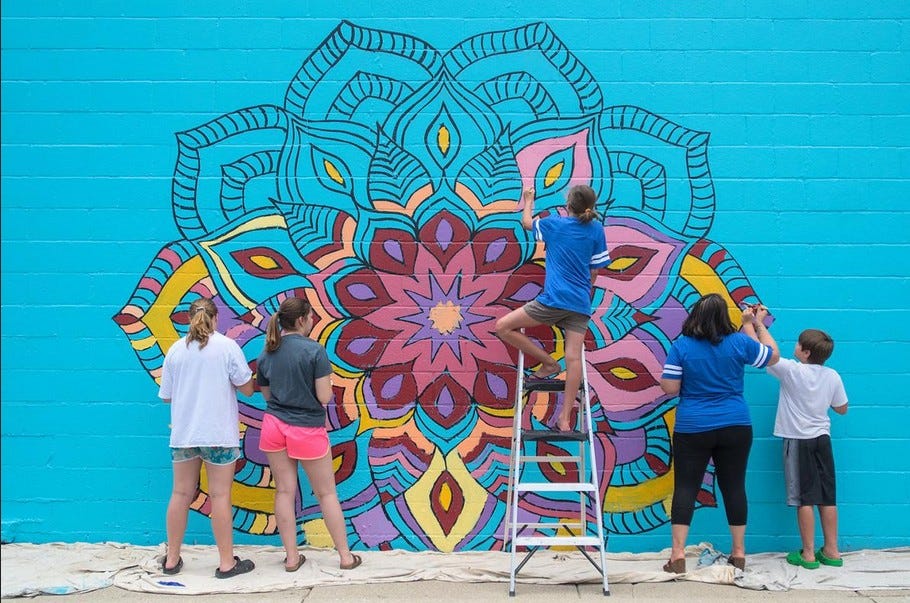
Since my twenties, I have been drawn into communities that are more egalitarian than hierarchical. At that time, I didn’t have the language for the inversion wound, but I could feel its absence in these spaces, and it was welcomed. Modeling something we deeply need, relational coherence.
Twelve-Step Program
I found my way into these rooms because of a dysfunctional eating issue. What I entered into was a mutual intention to understand addiction, to support one another, and to heal. This wasn’t a problem-solving space. No one was there to fix anyone. We weren’t simply meeting; we were gathering. Healing emerged through witnessing, listening and collaborating. That communal container facilitated my healing in ways nothing else could.
After about five years, the Eleventh Step carried me into another expression of community: “Sought through prayer and meditation to improve our conscious contact with God as we understood Him.” While the language of this step feels antiquated and exclusionary, the essence of surrender, alignment, and inner attunement, is what moved me.
The Ashram
The eleventh step inviting a longing I didn’t know existed; to a spirituality rooted in practice and lived experience rather than belief. This led me to a Hindu guru path, where I eventually moved into the local ashram for a year and half. A community that generated the most profound communal experience of my life.
Yes, there was hierarchy. Yes, I gave my power to a godhead, lessons I needed to learn. Yet, in this community, leadership existed more to foster engagement and personal transformation through relationships. We worked, practiced, struggled, ate and laughed together. We belonged.
It was here that I practiced seva, selfless service. Work offered not for recognition or reward, but as an act of care and giving. This reoriented my relationship with labor, value, and purpose. Work became relational, not extractive or transactional. That shift has never left me.
Family as Community
Ashram living and seva, later shaped how I lived with my husband and kids. Even today our children, now adults, continue to live with us as a collaborative household.
Shared living and pooled responsibility were once common across cultures. Being in groups, supported life! Our modern emphasis on isolation isn’t accidental; capitalism thrives on fragmentation. I didn’t plan on rebelling; I followed what seemed natural. In our home, responsibility is shared: financially, logistically, and emotionally. Made possible because we raised our children not as subordinates to control, but as beings we wanted to support, we trusted their unfolding.
Today, we’re “parents” only in age and genetics. Relationally, we’re a community. We love one another, honor our differences, and support the family as a living system.
Communal Restoration, Why Community Matters
At its core, the inversion wound is a forgetting, a loss of the understanding that life is relational, cyclical, embodied, and alive.
Healing this wound is not about flipping the hierarchy and choosing the “other side.” It’s about re-membering how to hold the whole again.
This wound cannot be healed in isolation. Its restoration must be communal.
Bringing back together what was torn apart: body and spirit, Earth and soul, masculine and feminine, dark and light, rest and action, mystery and knowing. This isn’t a return to some imagined past, but a restoration of balance, reciprocity, and relationship.
What Communal Restoration Looks Like:
EMBODIED WISDOM - naturally comes when the body is listened to and respected. Where lived experience is a valid form of knowing alongside our intellect, reason and intuition.
EARTH AS A LIVING BEING - is re-sacralized. She’s our home, not a backdrop. Land isn’t property, water isn’t a commodity, and nature isn’t separate from us. Ecological healing and spiritual healing are the same work.
RELATIONAL VALUES - are the feminine qualities of care, tending, grief work, midwifery, healing, teaching, and stewardship. These are central communal roles, not to be marginalized.
SLOWNESS IS PERMITTED - where pause, ritual, and integration are recognized as essential to wisdom. Where time is seen more as cyclical, seasonal, and responsive to life itself.
RITUALS - are lived practices that mark the thresholds of life, birth, death, loss, transformation, initiation, change, etc. Reminding us that life is sacred. Bringing deeper meaning to the liminal.
BELONGING - to our bodies, the land, and one another. All connected as the great web of life. We were never meant to be divided; relationality is our natural state.
HEALING THE SPLITS - happens by releasing polarization. Strength then includes vulnerability, leadership includes listening, power is shared.
The inversion wound taught us separation, hierarchy, and mistrust.
Restoration teaches us relationship, reciprocity, and remembrance.
This is slow work. Ancestral work. Living work.
And it happens every time we choose
connection over conquest,
attending over dominance,
and wholeness over polarity.
Community isn’t a luxury,
it’s how we re-member who we are together.
In this essay we explored what restoration can look like as community. But what are the mechanisms of this change, how is it implemented? I plan to continue writing about this in future posts. But I want to cultivate this together! Tell me about your experiences, your thoughts. Let’s have a conversation! Here are some questions for consideration…
⇨ Where have I internalized separation, how does that shape how I live?
⇨ How am I being invited to re-member, to bring back together what has been split?
⇨ What kind of community do I long for, and what relational step can I take now?

Offerings:
I offer tarot readings and one-on-one sessions, a held space of reflection designed to accompany your inner explorations, integrations and alignment with the rhythms of life. If this resonates, feel free to send me a message or visit my website for more information.
Thanks for reading!
I’m grateful you’re here! If this spoke to you, please click the heart, write a comment, restack or subscribe. It helps extend the conversation beyond this space. 💜
I'm so glad you wrote this! So beautiful! It's so necessary to name the inversion wound and to make the reclaiming of connection as the next steps. I'm also glad you said that it's not about flipping to the other side. To me, making the inversion wound "wrong" is just another way to perpetuate hierarchy. I think the invitation of the more relational way/integral consciousness is to include the inversion within the wholeness. Thank you for being such a wise leader in these times! So inspired by you! 💖💖💖
Julie, This is one of your most powerful and necessary essays. Yes, to keep writing. I resonate with every word. "Healing begins by naming what has been lost and suppressed by telling the truth about the patriarchal and hierarchical narratives that have shaped us." Keep writing. I'm always at your back, walking with you, together, sister. xoxo my friend, thank you!